Weather Patterns in Cupertino, CA: Seasons, Heat, Rain, and What to Check
Weather patterns in Cupertino, CA follow a mild Mediterranean cycle, but fire hazard zones and a 13-day median market make pre-offer checks non-negotiable.
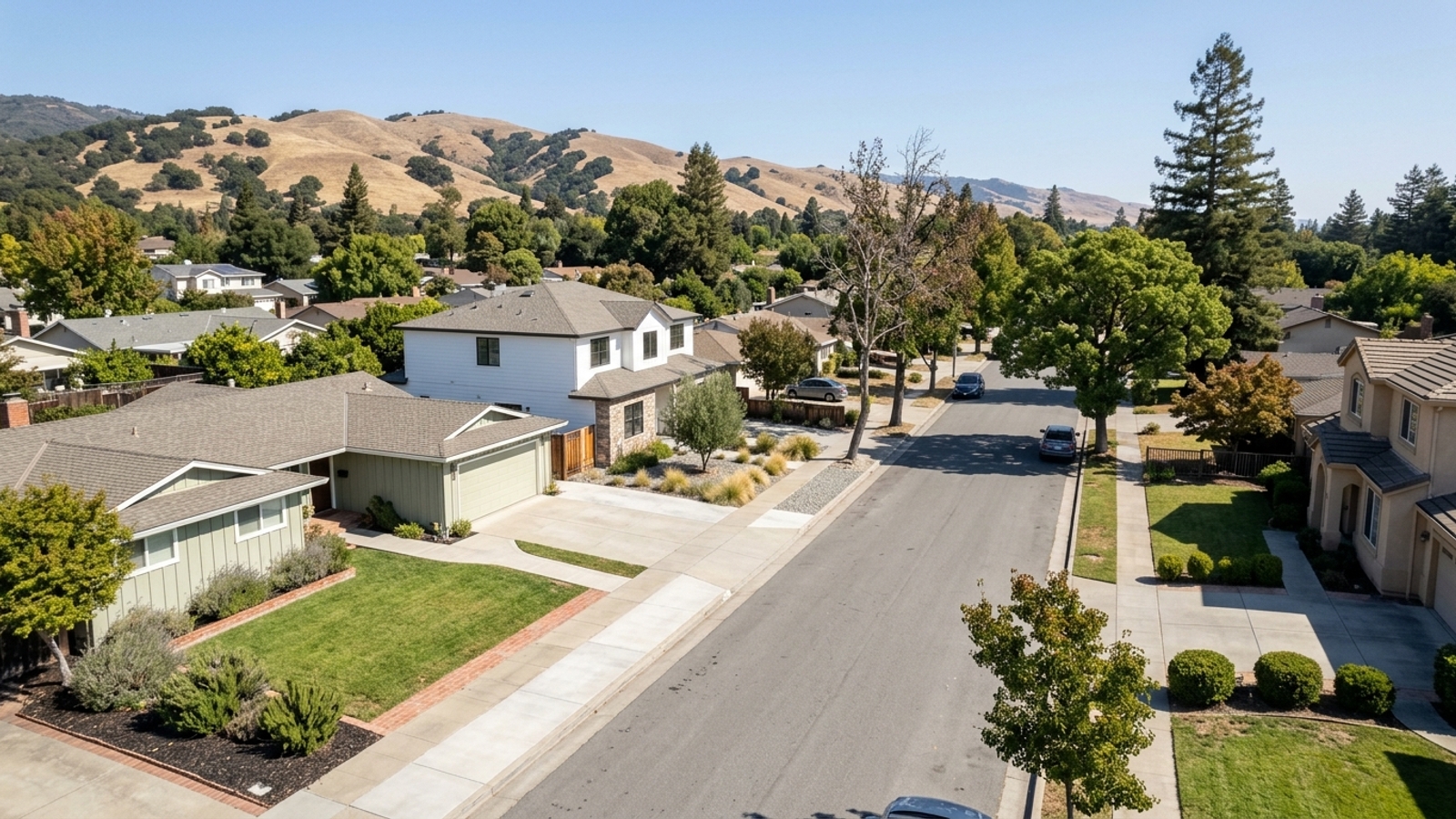
Cupertino, CA, sits at the edge of the Santa Clara Valley against the Santa Cruz Mountains. Aggregator sites classify the city under the Köppen system as Csb, a Warm-Summer Mediterranean Climate, meaning mild, dry summers and cool, wet winters.
Because the climate is generally mild, weather patterns in Cupertino, CA, rarely dictate whether someone moves here. The questions that decide a purchase are where in the city the home sits and what the house has: fire hazard zone mapping, cooling and filtration systems, lot drainage. With homes selling in a median 13 days (all homes, 90 days ending 2026-09-30), you won't live through a heat spell, a smoke week, or a winter storm before you close.
Key Takeaway
Cupertino has a mild Mediterranean pattern, with dry, warm summers and a short wet winter, so weather is rarely the reason to rule it out. The real decision is where in the city and which house. Start on valley-floor streets if you want to avoid mapped wildfire hazard zones, or look at the western foothills if you want a hillside setting and accept extra fire and insurance checks. Homes sell in a median 13 days (all homes, 90 days ending 2026-09-30), so do those checks from records before you tour, not after a season.
Who This Guide Is For
You're considering a home in Cupertino and want to know whether its weather, and the weather risks tied to a specific street or house, should change where you search or what you check before you make an offer.
What to Expect from the Climate in Cupertino
Most of the year in Santa Clara County breaks into two practical seasons: a long dry period and a concentrated wet winter. That's it. Two blocks of time, and the conditions that stress a house are almost entirely different in each one.
That divide shapes every home tour. What to look for depends entirely on which half of the year you're buying in.
Dry Season from Late Spring to Fall
Rain is largely absent through the summer months. Warm, dry, mostly sunny days transition into evenings that cool off, which shapes daily life from yard watering schedules to when you want to be outside.
Dry months are also when heat spells and wildfire smoke arrive. A house without adequate cooling, or with leaky windows, is at its worst in exactly the season you can't preview during a short sale window. On a dry August afternoon, you won't see how the property handles water, so ask the seller about the age of the roof and gutters and look at the grading around the foundation while you're there.
Rainy Season in Winter
Most of the year's rain falls in a compact winter window. It's cool but rarely cold enough for snow on the valley floor. Storms tend to come in bursts, and those bursts test roofs, gutters, and lot drainage more than the total annual rainfall figure suggests.
That burst pattern is exactly what a summer showing hides. Look up the address on the FEMA Flood Map Service Center and ask the seller about any past water intrusion. Cupertino participates in the FEMA National Flood Insurance Program, and properties in the city can fall within FEMA-designated Special Flood Hazard Area Zone A or AE.
How Weather Varies Across the City
The city rises from the valley floor into the foothills by a few hundred feet or more. That elevation change creates the main geographic divide for homebuyers, and it's not subtle once you start looking at hazard maps and insurance quotes.
Moving west toward the mountains alters the terrain and the regulatory picture. The differences shape what you pay for insurance and what maintenance the state requires.
Foothill Streets on the West Side
Higher ground toward the Santa Cruz Mountains brings hillside settings and views. Visit a hillside street once on a hot afternoon and again in the evening to feel the temperature difference yourself. Hazard mapping, though, is the defining difference between these streets and the valley floor.
Hillside streets are the ones most likely to fall inside a mapped Fire Hazard Severity Zone or wildland-urban interface rules. That can mean defensible-space work, ember-resistant construction requirements, and harder-to-get insurance. Check the exact address before you fall for the view. To see how this fits into your broader search, compare neighborhoods in Cupertino.
Valley Floor Streets
Most homes sit on flatter ground with the typical Santa Clara Valley pattern of warm afternoons and mild nights. This is the simpler starting point if wildfire mapping is your main concern, but it still needs an address-level check.
Flat ground is not risk-free. Summer heat still builds, smoke from distant fires still drifts in, and low spots should still be checked against the FEMA flood map and for local drainage. Don't skip that step just because the street looks straightforward.
Weather Risks to Check Before Buying a Home
On February 24, 2025, CAL FIRE's Office of the State Fire Marshal released updated Local Responsibility Area Fire Hazard Severity Zone maps covering Cupertino. The city reviews and adopts ordinances consistent with these new moderate, high, and very high zone designations.
Those maps dictate the defensive work you must do around the property. They also influence whether standard insurance carriers will write a policy for the address at all.
Wildfire Hazard Zones and Insurance
Look up the exact address on CAL FIRE's Fire Hazard Severity Zone map before you tour, not after you're in contract. Under California Civil Code Section 1103, a seller of residential real property must complete a statutory Natural Hazard Disclosure Statement identifying whether the property lies in a Very High Fire Hazard Severity Zone. Cupertino's Municipal Code requires defensible space to be maintained around all buildings within the city's designated Wildland-Urban Interface Fire Area.
The California Department of Insurance regulates the FAIR Plan, the state's insurer of last resort, which recently raised residential coverage limits to $3 million per location. The hazard disclosure often arrives after you're already in contract. Pull the map and an insurance quote yourself before you offer, or you'll find out about coverage costs and options only once your negotiating position is gone.
Summer Heat, Cooling, and Smoke
Heat spells and wildfire smoke days change how a house feels to live in. Check local air district advisories for smoke and Spare the Air days to get a sense of how often these conditions occur. Ask the seller whether the home has central air or only window or ductless units, and find out the system's age, its permit history, and whether the HVAC can take a higher-grade filter.
For condos and townhomes, ask the HOA whether owners may add air conditioning and what the rules are for window or ductless units. This varies across the types of homes in Cupertino. Many homes here were built for a mild climate, so cooling and filtration upgrades may fall entirely on you.
How the Fast Market Affects Weather Checks
Single-family homes in Cupertino recently sold at a median of $3,018,797, representing an 11.1% drop year over year. Despite that, homes still close at 106.3% of list price. Lower prices have not bought buyers more time, or the ability to renegotiate after a bad inspection.
Weather due diligence has to happen before the offer. Pull the hazard map, request the Natural Hazard Disclosure, get an insurance quote, check the flood map, and ask your HVAC questions upfront. When buying a home in Cupertino, front-loading this work is the only way to protect your timeline.
Sellers can speed things up by pre-ordering the hazard disclosure and documenting HVAC and roof work before listing their home in Cupertino. Andy Tse's team can help pull these reports before you write an offer. Review Cupertino housing market trends for more on pricing.
Is the Local Climate a Good Fit for You?
It comes down to a few practical questions. Is summer heat or winter rain the bigger concern for you? Are you drawn to hillside streets on the west side of the city? Does the home you're eyeing have central cooling and room for better air filtration? Can you finish hazard, insurance, and inspection checks in under two weeks?
Start on valley-floor streets if you want the least wildfire-zone mapping to deal with. Start on foothill streets on the west side if you want a hillside setting with views and possibly cooler evenings, provided you run a fire hazard map lookup, a defensible-space review, and an early insurance quote. Start with a showing during or just after a winter storm, plus a FEMA flood map lookup, if judging how a home handles heavy rain matters to you.
To weigh these factors against commute times and amenities, review the pros and cons of living in Cupertino.
At a Glance
- Median sale price, all homes: $2,848,643, down 6.9% year over year (90 days ending 2026-09-30, 76 sales)
- Median sale price, single-family homes: $3,018,797, down 11.1% year over year (90 days ending 2026-09-30, 58 sales)
- Median days on market: 13 for all homes, 12 for single-family homes (90 days ending 2026-09-30)
- Sale-to-list ratio: 105.4% for all homes, 106.3% for single-family homes (90 days ending 2026-09-30)
- Share sold above list price: 54.7% of all homes, 54.4% of single-family homes (90 days ending 2026-09-30)
- Months of supply: 2.5 for all homes (62 listings), 1.8 for single-family homes (33 listings) (90 days ending 2026-09-30)
- Median price per square foot: $1,597 for all homes, $1,630 for single-family homes (90 days ending 2026-09-30)
Cupertino Weather FAQs
Why Does My Weather App Show Cupertino?
Apple's Weather app and widgets can fall back to Cupertino, Apple's headquarters city, when location access is off or a default city is shown. Check your device's location settings to switch it to your own city.
Will El Niño Affect Cupertino's Weather in 2026?
The NOAA Climate Prediction Center's official ENSO outlook, updated October 26, 2026, tracks current conditions and outlooks for the upcoming 2026-27 winter. The exact impact on Northern California rain depends on how those patterns develop, so check the latest NOAA outlook rather than assuming a specific local outcome.
What Is the Weather Like in Cupertino Each Month?
The city experiences its warmest temperatures in late summer and its coolest in winter. The wettest months align with the winter season, while summer months stay mostly dry. Check current National Weather Service climate normals for specific monthly temperature and rainfall averages.
Does Cupertino Get Snow?
Snow on the valley floor is extremely rare. The nearby Santa Cruz Mountains do see occasional winter snow, though: a historic 2021 storm closed Highway 17, and a 2025 storm produced measurable snow at Saratoga Summit and Black Mountain.
Is It Humid in Cupertino?
Summers feel mostly dry rather than muggy. Morning coastal influence can bring higher humidity early in the day, but afternoons typically dry out.
How Far Is Cupertino from the Beach?
The city has no beach, so residents drive over the Santa Cruz Mountains via Highway 17 to reach the coast. Coastal fog and cooler air mostly stay on the ocean side of the mountains.
Is Cupertino in Southern California?
No. It's in Santa Clara County in the San Francisco Bay Area of Northern California. Its Warm-Summer Mediterranean climate brings a dry-summer pattern that differs from many Southern California microclimates. Check our Cupertino ZIP code guide for more area details.
Does Cupertino Have Water Restrictions During Droughts?
Addresses here are served by more than one water company, each with its own rules. As of late 2026, San Jose Water Company has no mandatory stage in effect, while California Water Service is in Stage 1 of its voluntary-conservation plan with no irrigation-day restrictions. Confirm the provider for your specific address to check current rules.
Sources
- Redfin: Data Center
- Plantmaps: Cupertino Climate
- City of Cupertino: CAL FIRE's Updated Fire Hazard Map
- City of Cupertino: Municipal Code WUI Defensible Space
- City of Cupertino: Floodplain Management
- NOAA: ENSO Outlook
- San Francisco Chronicle: Bay Area Storm Snow
- San Jose Water: Drought Information
- California Department of Insurance: FAIR Plan
- California Legislative Information: Civil Code 1103